The Beginning
(1940 - 1969)
1940
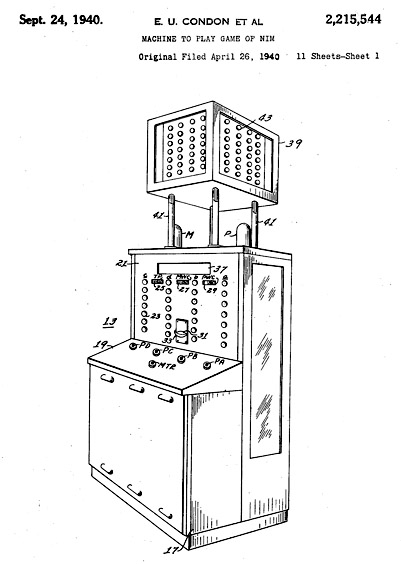
"For the Westinghouse display at the World's Fair, Edward U. Condon designs a computer that plays the traditional game Nim in which players try to avoid picking up the last matchstick. Tens of thousands of people play it, and the computer wins at least 90% of the games."

Sources:
Img:
1947
In 1974 the first cathode ray tube (the screen) was patented by Thomas T. Goldsmith JR. and Estle Ray Mann, There creation lead to the start of the video game era. They were used by the military for missile defense systems in the late 40's, then in the early 50's based defense workers started to create more complex video games.

Sources:
Img:

1950
Chess a common game for two people made single player, a man called "Claude Shannon lays out the basic guidelines for programming a chess-playing computer in an article "Programming a Computer for Playing Chess." That same year both he and Englishman Alan Turing create chess programs."
"Charly Adama created the "Bouncing Ball" video game program for MIT's new Whirlwind Computer, the first computer
to display "real-time" video signals, which was first demonstrated in April 1951 after being developed in the late 40's."
1951
One of the first Computers created in England was the "Pilot ACE computer", it was built at the "National Physics Laboratory ( NPL)". Christopher Strachey ("Born November 16, 1916, Hampstead, London, UK- died May 18, 1975") He stared of studying radar research, he then in 1951 designed a checkers/ draughts which ran on the "Pilot ACE Computer.
Sources:
http://www.museumofplay.org/icheg-game-history/timeline/
http://www.bmigaming.com/videogamehistory.htm#sthash.rLcoulNB.dpuf
http://eclecticplanet.org/tech/computer/twentieth/50s.html
http://history.computer.org/pioneers/strachey.html
1952
"A. S. Douglass creates OXO (a game known as noughts and crosses in the United Kingdom and tic-tac-toe in the United States) on Cambridge's EDSAC computer as part of his research on human-computer interactions."
Source:
http://www.museumofplay.org/icheg-game-history/timeline/
1960
"Computer programmer John Burgeson stays home sick from work at IBM and begins developing a computer baseball simulation. A month later (in January 1961), aided by his brother Paul, John runs this first-known baseball computer program on an IBM 1620 computer."
John Burgeson a computer programmer, working for IBM in Akron, Ohio, Called in sick, whilst working at home he started to create a "computerized fantasy baseball" game with a little help from his brother Paul. This was the first known baseball simulator that ran on a 1960's IBM Computer.
Sources:
The Golden Era
(1970 - 1985)
1970
"Scientific American publishes the rules for LIFE in Martin Gardner's "Mathematical Games" column. In this simulation, isolated or overcrowded cells die, while others live and reproduce. Hackers rush to implement it on their computers, watching beautiful patterns emerge and change."
Sources:
Sources:
1971

The first "Arcade game" would be at the start of the golden age, it was called "Galaxy Game" a very simple game with three modes of game play:
Positive Gravity
Sun (& Gravity)
Slow speed
Two Player
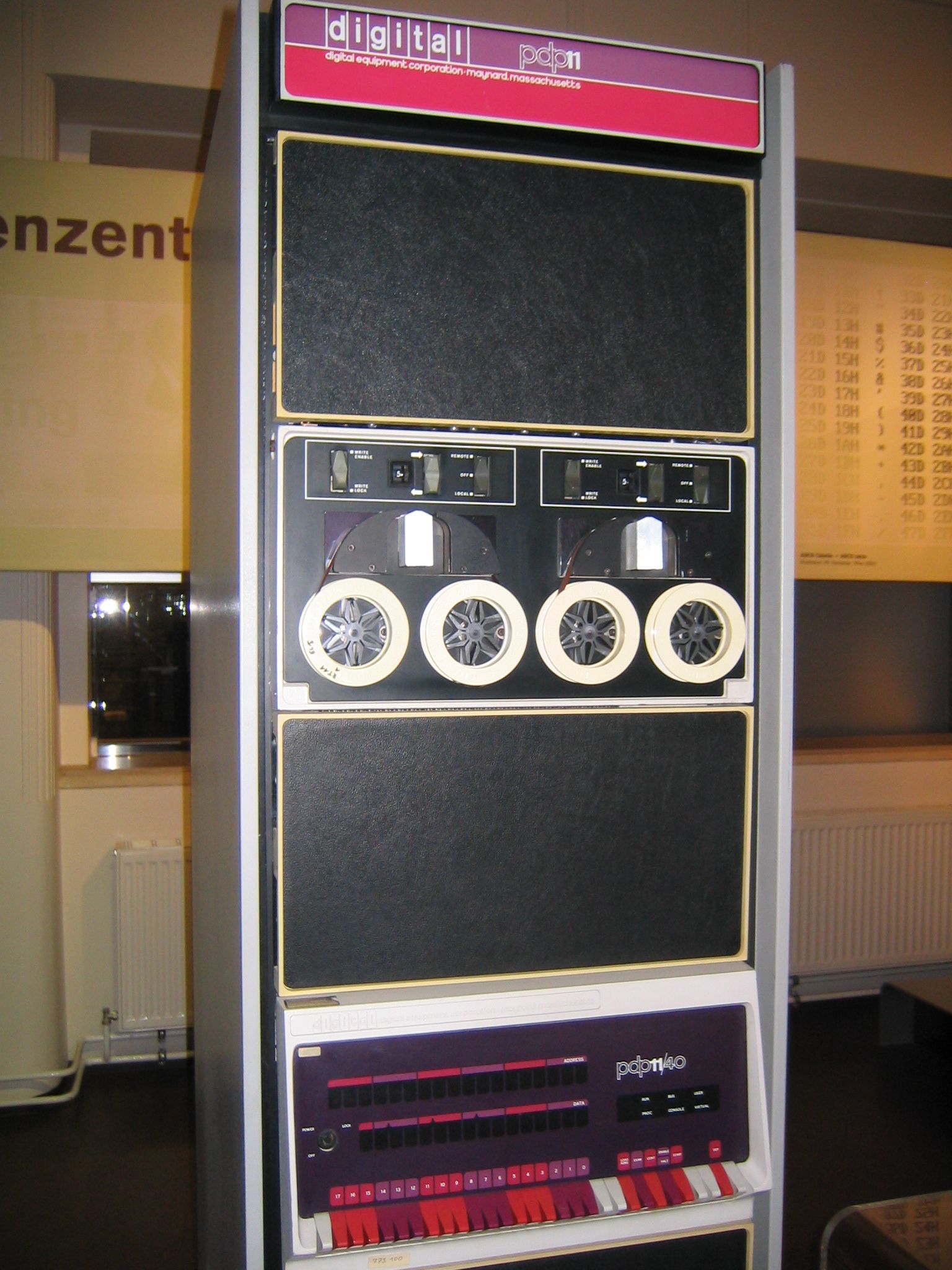
This is know as the very first coin operated arcade machine, it cost 10 cent per play or 25 cent for 3 games. It was created in Stanford University, the game cost about $20,000 to build and it used a DEC PDP-11 Computer, it was also the first game to use a Vector display terminal.

Also in 1971, Nolan Bushnell and Ted Dabney co-created a coin-operated video arcade game and called it Computer Space.
Sources:
https://www.youtube.com/watch?v=rVprIIDDLYY
http://www.museumofplay.org/icheg-game-history/timeline/
https://upload.wikimedia.org/wikipedia/commons/e/ee/Pdp-11-40.jpg
http://www.bmigaming.com/videogamehistory.htm
"In 1972, PONG, a tennis sports video game featuring simple 2D
graphics is released and becomes the first commercially successful coin
operated video arcade game in history. PONG quickly became a huge hit and its success led to the start
of the modern video game industry as we know of today. PONG went on from that
point to be a great success for Atari, Inc."https://www.youtube.com/watch?v=rVprIIDDLYY
http://www.museumofplay.org/icheg-game-history/timeline/
https://upload.wikimedia.org/wikipedia/commons/e/ee/Pdp-11-40.jpg
http://www.bmigaming.com/videogamehistory.htm
1972
Pong was developed by Nolan Bushnell and Ted Danbey but the actual game was created by Allan Alcorn, from their ideas – This became the first coin operation arcade game. Allan Alcorn was not a video game designer, but due to his experience in electrical engineering and computer science, he got asked by Nolan Bushnell to create the game Pong, a simple 2d game with a moving ball, two paddles and a simple scoring system.
Golden Era
"The Golden Era saw
the development and experimentation with new game hardware and human interface
devices (HID) in video arcade games. New games were created using "vector
display" monitors, which produced crisp lines as opposed to older
"raster displays", and new player controls cropped up using more than
joysticks and buttons - Atari introduced the first life-like steering wheel in
Gran Trak 10 (1974), and again in a sit-down driving game called Night Driver
in 1976, along with the first arcade game trackball in the 1978 Atari title Football,
and also introduced the first light guns ever used in video games with Atari's
QWAK (1974) along with Hogan's Alley by Nintendo later. Many new arcade game
controls, such as pedals in racing arcade games and many other unique arcade
game player control innovations also debuted in this era."
1980

"
"

Sources:

The End Of The Golden Era
(1970 - 1985)
The Windows Era
(1990+)
1990
"On May 22, 1990, Microsoft announces Windows 3.0, followed shortly by Windows 3.1 in 1992. Taken together, they sell 10 million copies in their first two years, making this the most widely used Windows operating system yet. The scale of this success causes Microsoft to revise earlier plans. Virtual Memory improves visual graphics. In 1990 Windows starts to look like the versions to come."
Microsoft windows OS System was and is still a huge success, Most people prefer to use the Windows OS even today, over 50% of OS users use Windows 7, The rest also fall in to most other window OS versions

| 2015 | Win10 | Win8 | Win7 | Vista | NT* | WinXP | Linux | Mac | Mobile |
|---|---|---|---|---|---|---|---|---|---|
| August | 3.5% | 19.4% | 47.2% | 1.2% | 0.3% | 3.6% | 5.4% | 10.9% | 5.0% |
| July | 23.1% | 48.6% | 1.4% | 0.1% | 4.0% | 5.6% | 11.4% | 5.0% | |
| June | 23.3% | 50.7% | 0.7% | 0.1% | 3.4% | 5.9% | 9.9% | 5.4% | |
| May | 23.5% | 51.1% | 0.7% | 0.1% | 3.3% | 5.5% | 10.2% | 5.4% | |
| April | 22.8% | 52.1% | 0.7% | 0.1% | 3.6% | 5.2% | 10.2% | 5.0% | |
| March | 22.2% | 52.3% | 0.7% | 0.1% | 4.1% | 5.3% | 10.1% | 5.0% | |
| February | 21.3% | 52.5% | 0.8% | 0.1% | 4.5% | 5.4% | 10.1% | 5.0% | |
| January | 21.0% | 52.8% | 0.8% | 0.1% | 4.7% | 5.5% | 9.8% | 5.0% |
Sources:
2000
Sony Releases the PlayStation 2, it was the first 128 bit console, it also features backward compatibility, meaning it could play older PlayStation 1 games - Also it could function as a dvd player, The PlayStation had many well know titles such as GTA, Metal Gear Solid and Final Fantasy.

"The PlayStation 2 was released in March of 2000 in Japan, October in North America and November of that year for eager western consumers. Day one sales were phenomenal, with the PS2 pulling in combined sales to the tune of $250 million. Thanks to a massive install base established throughout the world with the PS1 and the backwards compatibility options available, the PS2 sold over 980 000 units in Japan alone in one day."
Sources:
2001
"It took two years for Microsoft to go public with its console. Bill Gates eventually showed it off at 2000’s Game Developer’s Conference, touting its “next gen” features. It was the very first console to feature a hard drive and built-in networking for broadband connections. Attendees were wowed by the hardware, but developers weren’t all that keen to jump straight in, with most seeing it as little more than PC in a set-top box."

Xbox's struggle started in 1998 where a team of Microsoft Employees convinced Bill Gates to create a Console, so two years later Bill Gates released the Xbox. This is one of the best things microsoft did due to is growth, The online service Xbox live delivered gave the user the ablity to talk, chat and play with other people.
Scorces:
The War
Xbox (Microsoft) VS PlayStation (Sony)
2013
"The current rivalry between the Xbox 360 and the coming PlayStation 3 is just the latest battle in the exciting leadership war that began in 2001, when Microsoft introduced the original Xbox into the console market. The PlayStation was the reigning champion of the console market. It had dominated since the mid-90s. The original PlayStation sold some hundred million units, a staggering figure at the time. "

"The PlayStation 4 and Xbox One have been marketed as the most powerful consoles ever made, with the processing power and memory to match that of today's PCs."
This doesn't really oppose a threat to PC games due o the one thing you can do with a console. Upgrade its hardware, with PC you can constantly change the hardware aspect. with PS4 and Xbox one the games will have to stay at what the can max out. From my own opinion i believe that PC will soon over take console to a point where consoles will stop being produced.
"The launch of the new consoles also opens up more opportunities for PC game developers. According to Wardell, many PC game developers didn't even consider bringing their games to the PS3 and Xbox 360 because of the restrictions they ran up against. Doing so often meant sacrificing quality, content or both. Now that the consoles have been brought up to speed, Wardell believes this is the first generation of consoles that Stardock feels it could potentially target."
Sources: